Understanding Your Medal
A sign of faith, an invitation to prayer, and a reminder of Christ in daily life.
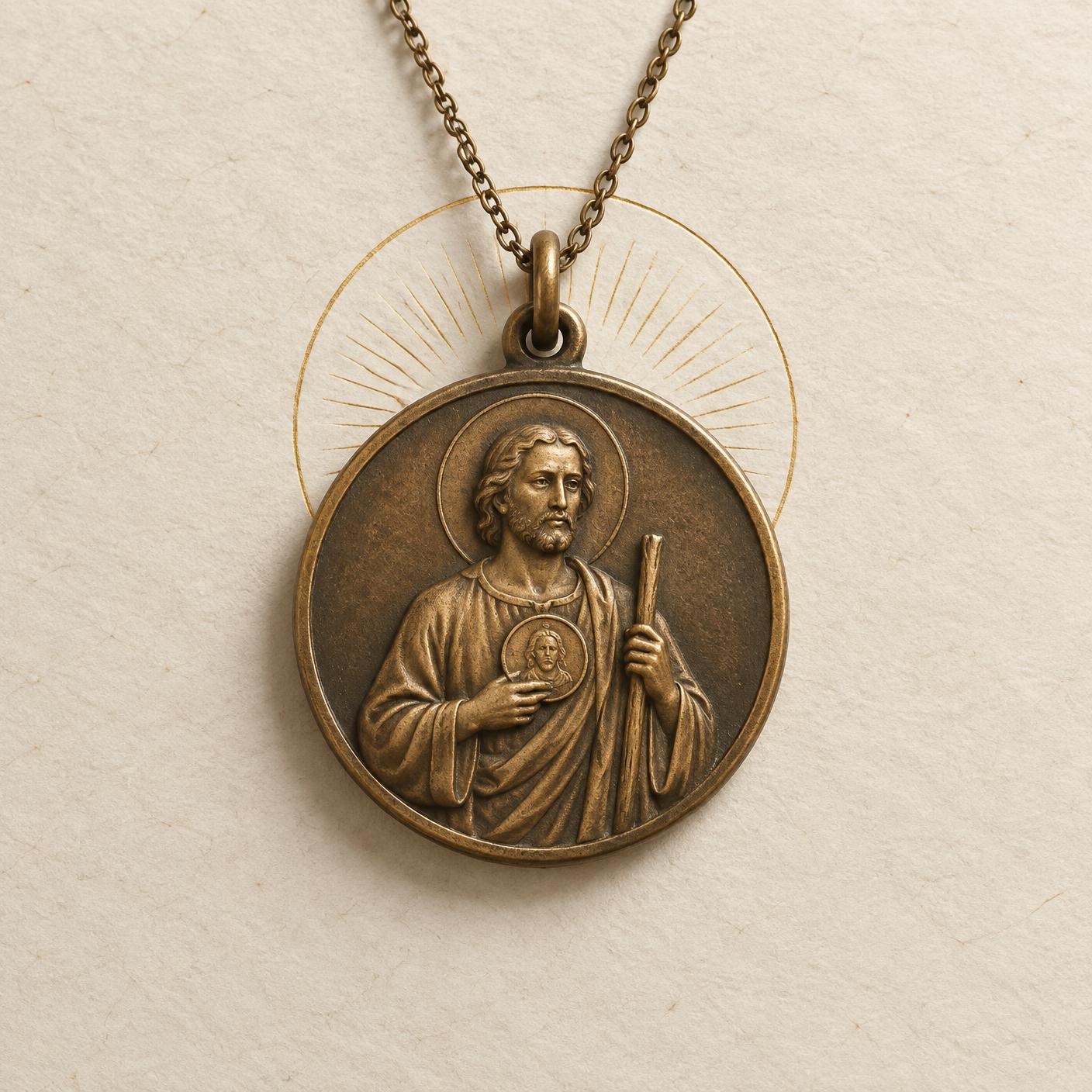
You have received a medal depicting St Jude Thaddeus. This small object invites you to discover an apostle of Jesus Christ and to understand the place a visible sign can have in a journey of faith.
Its images and inscriptions belong to the language of Christian art. They evoke a person, a witness, and an invitation to live the Gospel.
What is the meaning of a Catholic medal?
A Catholic medal is an object of devotion. It may depict Christ, the Virgin Mary, a saint, or a Christian symbol.
Wearing or keeping it can help us remember God amid our daily activities. It can recall a prayer intention, accompany a moment of prayer, or discreetly bear witness to faith.
The Catechism lists medals among the expressions of popular piety that accompany Christian life. These practices lead us toward the life of the Church and its sacraments; they do not replace them. Catechism of the Catholic Church, nos. 1674–1675
The medal of St Jude thus reminds us of a man called to follow Jesus. It invites us to ask for his prayers and to follow Christ ourselves in the circumstances of our lives.
Recognizing the symbols on your medal
On this side of the medal, St Jude is depicted with several attributes that invite us to discover his vocation as an apostle.
The name of St Jude Thaddeus
The inscription at the top, “ST. JUDE THADDEUS,” identifies the apostle depicted. He should not be confused with Judas Iscariot.
The face of Jesus: the Image of Edessa
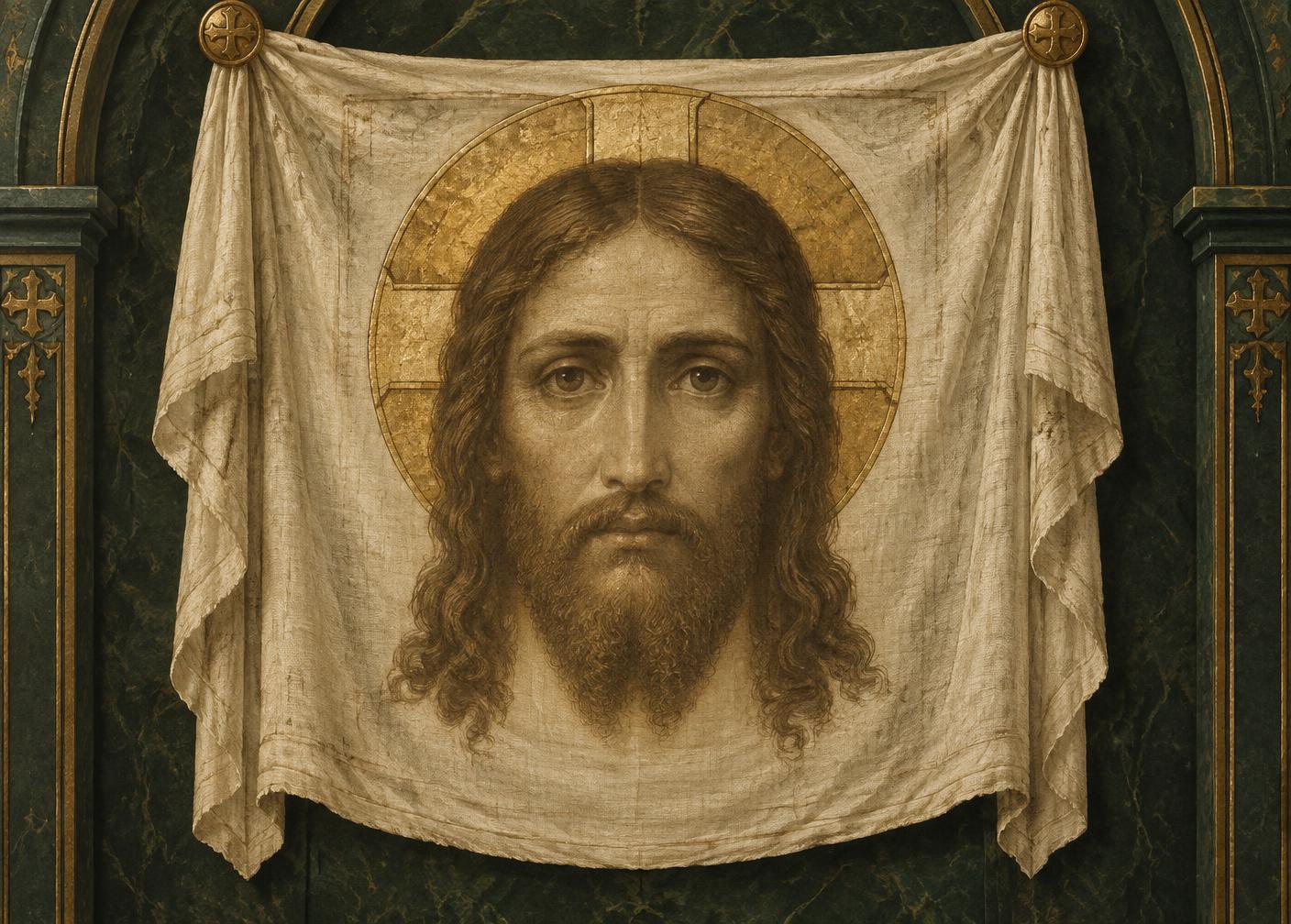
The face of Jesus appears on St Jude’s chest. This attribute traditionally refers to the Image of Edessa, also known as the Mandylion.
According to a Christian tradition, Abgar, king of Edessa, was gravely ill and sent a messenger to ask Jesus to come and heal him. Some versions recount that Jesus imprinted his face on a cloth intended for the king. They also associate the king’s healing and his acceptance of the faith with the arrival of a disciple named Thaddeus. This story became part of devotion to St Jude and explains the image of Christ that he bears in many depictions. St Jude Shrine — The Mandylion of Edessa
The details of the account vary among traditions. It is not an episode recounted in the New Testament, nor is it a historically certain biography of the apostle.
In Eusebius’s account, this Thaddeus is presented as one of the Seventy disciples, not as one of the Twelve. His identification with Jude Thaddeus should therefore not be considered certain.
On your medal, this image above all recalls the central place of Jesus Christ. St Jude bears witness to him and invites us to turn to him.
The halo around his head
The circle surrounding St Jude’s head is a halo. In Christian art, it is a sign of holiness.
It expresses the saint’s belonging to God and the light of God’s presence. It does not represent an independent power: holiness has its source in God.
The staff: a possible reminder of martyrdom
St Jude holds a long, staff-like object. In his iconography, a staff or club may evoke the instrument of his martyrdom. Other depictions show him holding a halberd. These attributes reflect traditions concerning his death and his fidelity to Christ. St Jude Thaddeus in Art — Attributes and Depictions
The engraving on this medal does not allow us to identify the exact form of the object with certainty. It is nevertheless reasonable to see it as a possible reference to his martyrdom rather than describing it solely as a walking staff.
The precise circumstances of St Jude’s death have not been established with certainty. The spiritual meaning of this attribute is one of witness: remaining faithful to Christ even in times of trial.
“Pray for us”
The inscription at the bottom reads, “PRAY FOR US.”
These few words express the meaning of intercession: we ask St Jude to pray to God for us. Our trust rests in God, to whom the saint’s prayer unites us.
You can simply repeat this invocation:
St Jude Thaddeus, pray for us.
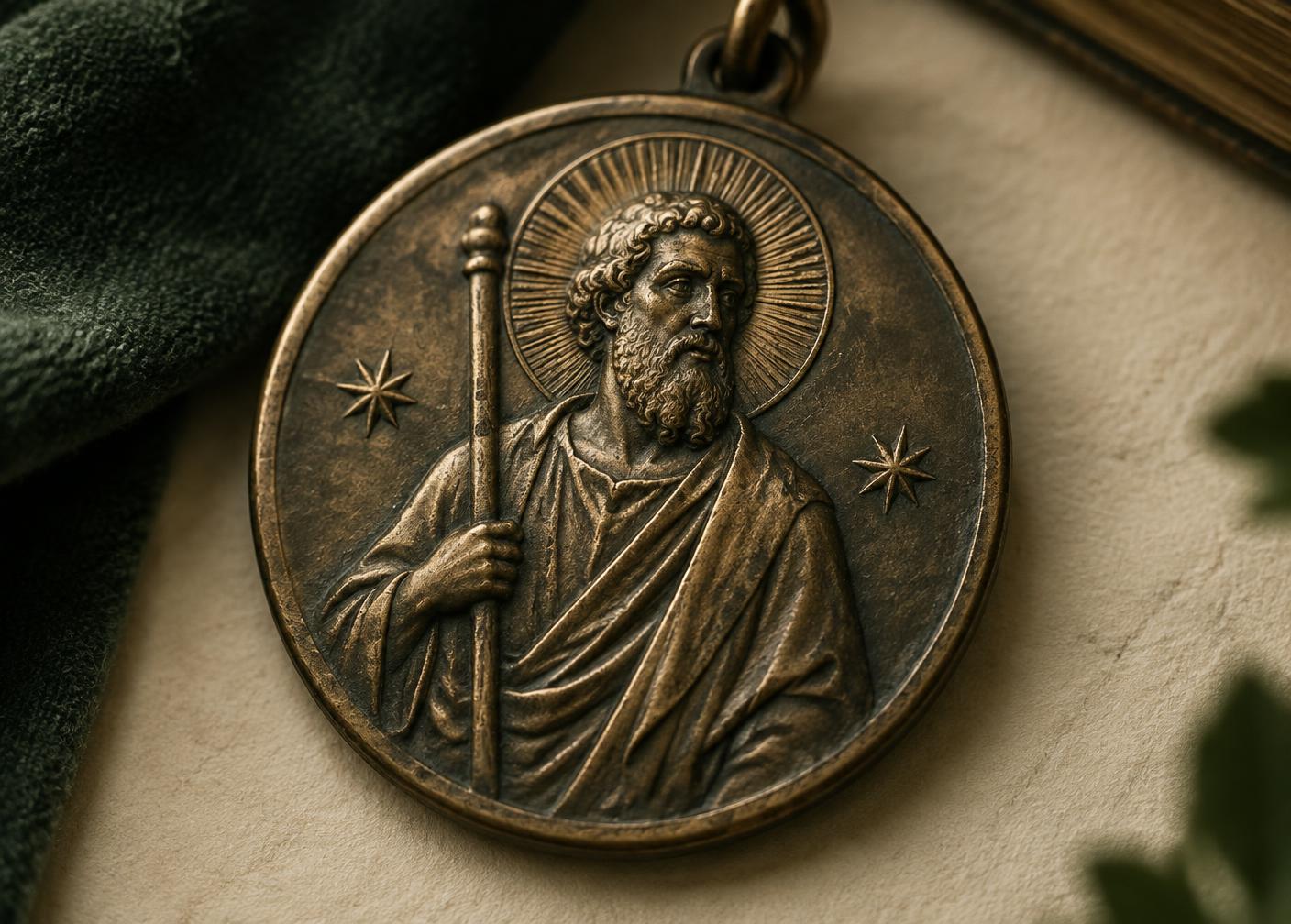
The two small stars
Two stars separate the inscriptions. We have no indication from the designer of this medal that they were given any particular religious meaning.
Without specific information from the manufacturer or designer, we do not assign them a precise religious meaning. Not every decorative detail is necessarily a symbol to be interpreted.
An image that leads to an encounter
Looking at a medal can become an opportunity to pause for a few moments.
You can remember Christ, entrust someone to him, or present your concerns to him. You can also simply ask:
St Jude, pray for us and, through your intercession, help us to follow Jesus Christ.
The value of this practice does not depend on the size of the medal, the metal from which it is made, or the precision of its engraving. A modest object can accompany a sincere prayer.
A medal, a blessing, a sacrament: what is the difference?
A medal is an object of devotion. It may be blessed by the Church.
This blessing is a sacramental: a sacred sign through which the Church prays and disposes us to receive God’s grace. Sacramentals are distinct from the sacraments, such as Baptism and the Eucharist.
A blessing therefore does not add magical power to the metal. It places the use of this object within the prayer of the Church and within a life directed toward God. Catechism of the Catholic Church, nos. 1667–1671
The meaning of a blessing and the steps for having your medal blessed are explained later on this page.
A reminder to trust in God
You may wear your medal or keep it respectfully in a place that helps remind you to pray.
It guarantees neither automatic protection nor healing or success. You do not need to hold it in your hand for God to hear your prayer.
Its purpose is to help you turn to God and allow that relationship to bear fruit in your life: greater care for others, fidelity, hope, and charity.
Through St Jude, lead hearts to Christ.
A medal in the life of faith
A medal can accompany you in daily life: worn around your neck, kept close to you, or placed somewhere conducive to prayer.
It can recall an intention, someone you love, or your desire to follow Christ. Its presence invites a simple response: turn to God, speak to him, listen to his word, and ask St Jude to pray for you.
The blessing of a medal is one of the Church’s sacramentals. Through this prayer, the Church asks God to help those who use this object to live their faith.
What is a sacramental?
Sacramentals are sacred signs instituted by the Church. Through the Church’s prayer, they dispose us to receive God’s grace and to respond to it in our lives. Blessings are among the sacramentals.
They are distinct from the seven sacraments, such as Baptism and the Eucharist. A blessed medal accompanies Christian life; it does not replace the sacraments. Catechism of the Catholic Church, nos. 1667–1670
The term may sound technical, but the idea is accessible: everyday objects and gestures can help us live our relationship with God.
What does it mean to have your medal blessed?
To bless is to praise God and ask for his gifts. In the blessing of an object of devotion, the Church prays that its use may help people live according to the Gospel. Catechism of the Catholic Church, nos. 1671 and 1678
The blessing does not transform the metal into a material endowed with power. It gives the use of the medal a place within the prayer of the Church: the medal becomes a blessed object and should be treated with respect.
You can receive this blessing as an invitation to renew your trust in God and your desire to follow Christ.
How can you have your medal blessed?
You may bring your medal to a priest and simply ask him to bless it when he is available. If you do not know a priest, contact a parish office.
If you do not know whether your medal has already been blessed, tell him. Its appearance cannot tell you whether it has been blessed.
You can already pray and explore the faith before taking this step. God does not wait for you to possess a blessed object before hearing your prayer.
What your medal is not
A good-luck charm or talisman
The medal does not automatically attract good luck or mechanically ward off difficulties.
In the Catholic faith, we can ask God for his protection. Our trust is placed in him; it does not rest on possessing an object.
The Catechism warns against superstition, particularly when magical efficacy is attributed to religious practices or sacramental signs apart from the interior dispositions they require. Catechism of the Catholic Church, no. 2111
A guarantee of a miracle or healing
Wearing a medal, even a blessed one, does not guarantee that your request will be answered as you wish.
A trial that persists does not mean that you have worn your medal incorrectly or that your faith is insufficient. You can continue to pray, express your sorrow, and seek the support you need.
A medal and prayer can accompany medical care or practical steps. They do not replace them.
A formula that must be activated
There is no secret gesture, required number of recitations, or particular way of holding the medal that will make it “effective.”
The inscription “Pray for us” is a request for intercession. You can repeat it freely and confidently without trying to follow a perfect procedure.
Likewise, removing your medal to sleep, bathe, or take part in an activity does not sever your relationship with God. Losing it or damaging it accidentally is not an omen of misfortune.
A substitute for Christian life
The medal accompanies a journey of faith nourished by prayer, Scripture, the sacraments, and life with others. Devotions are meant to lead us toward this life of the Church. Catechism of the Catholic Church, nos. 1674–1675
Wearing the image of an apostle can thus remind us of a simple question: How can I follow Jesus today in my decisions and relationships?
Wear your medal with respect and freedom
You may wear your medal discreetly or keep it respectfully. There is no need to display it to prove your faith.
If you are discovering Christianity, take time to understand what the medal represents. You can ask questions, read the pages on this site, or speak with a priest.
This medal was given to you free of charge. You have no contribution to make, no prayer to publish, and no obligation to fulfill in order to keep it.
Through St Jude, turn to Christ
The image of Jesus on your medal brings us back to the heart of this journey.
St Jude is an apostle of Christ. By asking him to pray for us, we seek to draw closer to God and grow in faith, hope, and charity.
Your medal can remind you of this invitation in the midst of an ordinary day. A moment is enough to entrust a concern to God, thank him, or think of someone who needs support.
You can begin simply:
Lord Jesus, help me to follow you today. St Jude, pray for us.
Through St Jude, lead hearts to Christ.