Who is St Jude Thaddeus?
An apostle of Jesus Christ, a witness to the Gospel, and an intercessor in times of trial.
You may have discovered St Jude by receiving a medal or hearing about the “saint of hopeless causes.” Before this devotion, there is a man called to follow Jesus: one of the Twelve Apostles.
We know few details about his life. To understand him accurately, it is important to distinguish among the witness of the New Testament, later Christian traditions, and what history cannot establish with certainty.
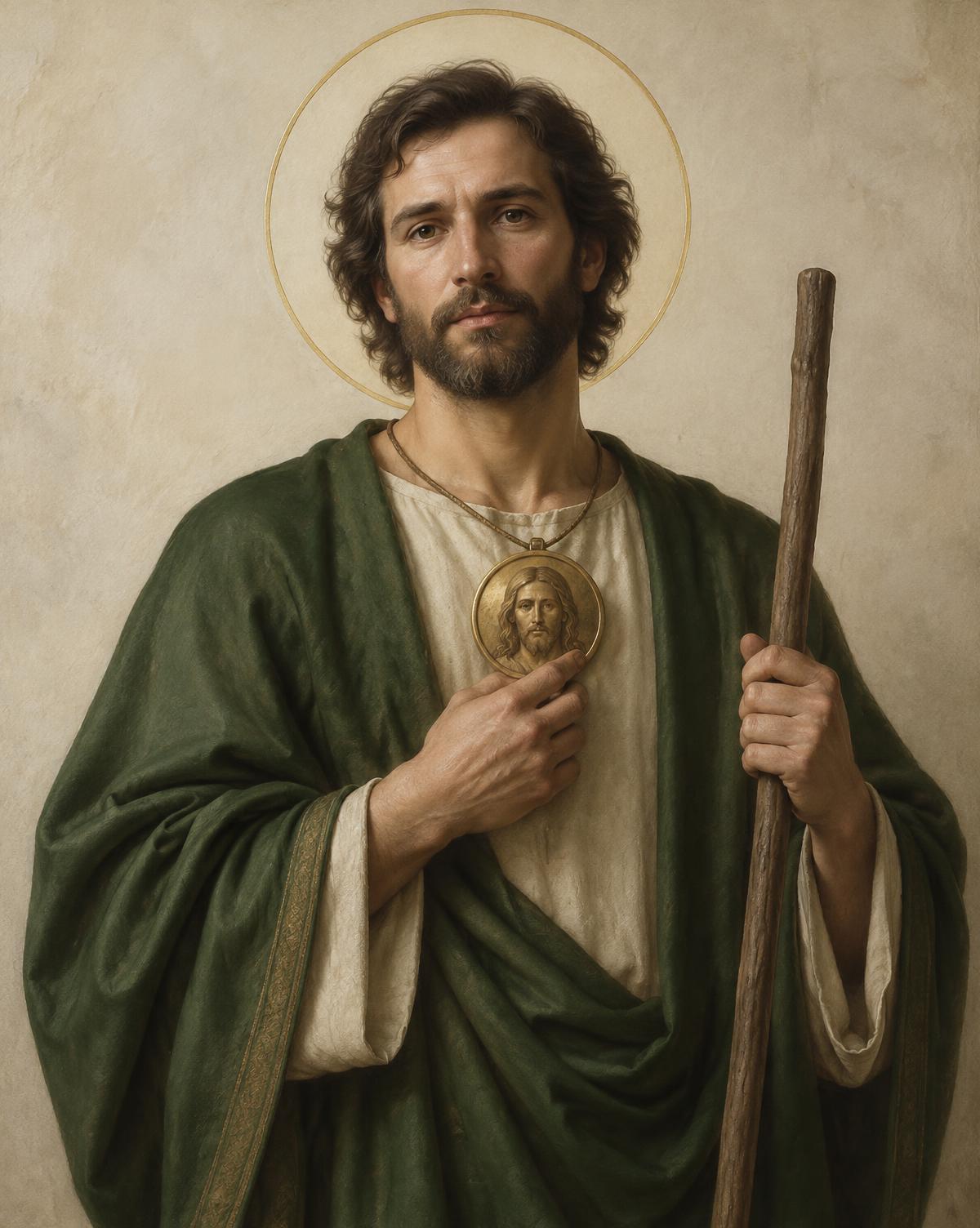
An apostle, not to be confused with Judas Iscariot
St Jude Thaddeus is not Judas Iscariot, the one who betrayed Jesus.
The lists of the apostles use different names: Matthew and Mark mention Thaddeus, while Luke and the Acts of the Apostles name Jude, son of James. Christian tradition identifies them as the same apostle, hence the combined name “Jude Thaddeus.”
Benedict XVI recalls this identification in his catechesis on Simon and Jude. He also notes that the origin of the name “Thaddeus” remains uncertain. We therefore do not need to assign it a definitive meaning in order to understand this apostle’s vocation. Benedict XVI, General Audience of October 11, 2006
A question addressed to Jesus
The Gospel according to John records a question from Jude during Jesus’ Last Supper with his disciples. The evangelist specifies that this is not Judas Iscariot.
Jude asks why Jesus will reveal himself to his disciples and not to the whole world. Jesus answers by speaking of love, fidelity to his word, and the Father’s presence with those who welcome him. John 14:22–23
This encounter can shed light on our own search. At times, we may want God to reveal himself in a spectacular way, immediately dispel our doubts, or answer our difficulties without delay. Jesus’ response invites us into a deeper relationship: to welcome him, listen to his word, and learn to live by his love.
Discovering St Jude thus means encountering a disciple who asks Jesus a question and enables us to hear his answer.
Present in the first Christian community
After the Ascension, the Acts of the Apostles names Jude among the apostles gathered in Jerusalem. Together they persevered in prayer with Mary, the mother of Jesus, and other disciples. Acts 1:13–14
This passage gives us a simple and solid point of reference: Jude belongs to this first community gathered in faith and prayer.
We can recognize in it an invitation for today. Christian faith is not lived solely as an individual undertaking: it is shared, supported, and also grows through encounters with other believers.
What about the Letter of Jude?
The New Testament contains a short letter whose author identifies himself as Jude, a servant of Jesus Christ and brother of James. It calls believers to remain faithful to the faith they have received, to pray, and to remain in the love of God. Letter of Jude, verses 1, 3, and 20–21
This letter has traditionally been associated with Jude Thaddeus. However, the identification of its author with one of the Twelve is not historically certain. Scholars distinguish the apostle Jude from Jude, a relative of Jesus, to whom they attribute the letter. The biblical introduction published by the United States Conference of Catholic Bishops presents this distinction. Introduction to the Letter of Jude — USCCB
It is therefore appropriate to speak of a traditional attribution without treating it as a biographical certainty. This historical question does not change the letter’s place among the books of the New Testament.
What tradition reports about his mission
The New Testament does not recount Jude’s missionary journeys or his death in detail.
Christian traditions place Jude’s mission in the East. Some associate his preaching and martyrdom with the apostle Simon, particularly in Persia. These accounts do not, however, allow us to establish his itinerary or the circumstances of his death with certainty. Overview of Traditions Concerning Simon and Jude — Vatican News
The Roman Catholic Church celebrates Saints Simon and Jude together on October 28. This feast honors their apostolic witness and their fidelity to Christ. Saints Simon and Jude — Vatican News

Why ask for his prayers in difficult situations?
Devotion to St Jude has found a special place among people seeking support in times of trial. It spread in the modern era in part through shrines and novenas: in Chicago, the National Shrine of St Jude records gatherings of the faithful beginning in 1929. This is one example of the modern growth of the devotion, not its sole origin. National Shrine of St Jude
The expression “hopeless causes” does not mean that St Jude possesses a power reserved for problems that God could not otherwise resolve.
In the Catholic faith, the saints intercede for us because they are united with Christ. Their prayer draws us closer to him; it does not replace his mediation. Asking for St Jude’s help therefore means asking him to pray for us before God. Catechism of the Catholic Church, nos. 956–957
This practice does not guarantee that events will unfold as we wish. We can ask for concrete help, but also for the strength to endure a difficulty, the light to make a decision, and the courage to accept support.
Through St Jude, turn to Christ
The medal you have received does not invite you to seek power in an object. It invites you to discover an apostle and, with him, turn toward Jesus Christ.
You do not need to know his entire life story to begin praying. You can simply present to God what is in your heart and ask, “St Jude, pray for us.”
You are free to continue this discovery at your own pace.
Through St Jude, lead hearts to Christ.